Get Free Ebook Forty Million Dollar Slaves: The Rise, Fall, and Redemption of the Black Athlete
Yeah, reviewing an e-book Forty Million Dollar Slaves: The Rise, Fall, And Redemption Of The Black Athlete could include your close friends lists. This is just one of the solutions for you to be effective. As understood, success does not imply that you have terrific things. Recognizing as well as understanding greater than various other will certainly provide each success. Beside, the message as well as impression of this Forty Million Dollar Slaves: The Rise, Fall, And Redemption Of The Black Athlete could be taken and also picked to act.
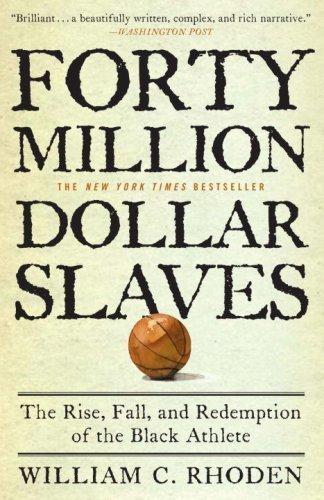
Forty Million Dollar Slaves: The Rise, Fall, and Redemption of the Black Athlete

Get Free Ebook Forty Million Dollar Slaves: The Rise, Fall, and Redemption of the Black Athlete
Find more experiences as well as expertise by reading the publication qualified Forty Million Dollar Slaves: The Rise, Fall, And Redemption Of The Black Athlete This is a publication that you are looking for, right? That's right. You have actually involved the best site, after that. We constantly offer you Forty Million Dollar Slaves: The Rise, Fall, And Redemption Of The Black Athlete and also one of the most preferred publications in the globe to download and delighted in reading. You could not dismiss that seeing this set is a purpose or perhaps by unexpected.
There is without a doubt that publication Forty Million Dollar Slaves: The Rise, Fall, And Redemption Of The Black Athlete will certainly still make you inspirations. Even this is merely a book Forty Million Dollar Slaves: The Rise, Fall, And Redemption Of The Black Athlete; you could find numerous genres and also types of publications. From captivating to journey to politic, as well as sciences are all given. As just what we state, below our company offer those all, from well-known writers and author around the world. This Forty Million Dollar Slaves: The Rise, Fall, And Redemption Of The Black Athlete is among the collections. Are you interested? Take it currently. How is the method? Find out more this short article!
When somebody needs to visit the book stores, search shop by shop, rack by shelf, it is quite frustrating. This is why we provide guide compilations in this site. It will certainly ease you to look guide Forty Million Dollar Slaves: The Rise, Fall, And Redemption Of The Black Athlete as you like. By looking the title, author, or authors of guide you really want, you can find them swiftly. In the house, office, and even in your way can be all finest area within internet links. If you intend to download the Forty Million Dollar Slaves: The Rise, Fall, And Redemption Of The Black Athlete, it is very easy then, considering that currently we proffer the link to acquire and make deals to download Forty Million Dollar Slaves: The Rise, Fall, And Redemption Of The Black Athlete So simple!
Curious? Certainly, this is why, we suppose you to click the web link web page to go to, then you can take pleasure in the book Forty Million Dollar Slaves: The Rise, Fall, And Redemption Of The Black Athlete downloaded up until completed. You can conserve the soft file of this Forty Million Dollar Slaves: The Rise, Fall, And Redemption Of The Black Athlete in your gizmo. Naturally, you will bring the gizmo anywhere, won't you? This is why, every single time you have extra time, each time you can appreciate reading by soft duplicate publication Forty Million Dollar Slaves: The Rise, Fall, And Redemption Of The Black Athlete
- Sales Rank: #1137229 in Books
- Published on: 1709
- Binding: Paperback
Most helpful customer reviews
81 of 94 people found the following review helpful.
The Paradox of the "Slave Athletic Celebrity"
By M. JEFFREY MCMAHON
Rhoden's aim in this finely written and very readable screed is to explore the African American star athlete's paradoxical dilemma: On one hand, he is worshipped for his athletic prowess and is lavished with millions of dollars. On the other hand, he is beholden to white team owners, white league administrators, and as such is limited to the role of a super-paid lackey.
Some reviewers object to the slavery analogy and the exodus from the plantation to the Promised Land that is heavily used in Rhoden's argument. But Rhoden is correct to point out that the slavery is both spiritual and power-based. Spiritual because too many African American athletes, Rhoden charges, are so busy micromanaging their careers that they have no sense of the broader context, of African American history (one star athlete was shocked with disbelief when he discovered that blacks were once banned from Major League Baseball). Power-based because too many blacks are relegated to "black" roles and forget the larger mission of making more opportunities for blacks in positions of privilege.
Whether or not you agree with Rhoden's analogy, I would argue that the book is nevertheless very readable and entertaining, giving us powerful narratives of how black men, starting with the emancipated slave fighter Tom Molineaux, left America to fight the English champion Tom Cribb and showed whites that blacks' athletic performance defied stereotypes about being dense, ignorant, maladroit, etc. By studying Molineaux, Ali, and other African American greats, Rhoden shows how black athletes who see themselves as symbols of black power help forge the way for other black athletes.
On a personal note, Rhoden, an African American, explains in his own life growing up in Chigaco in the 1950s and 1960s, that sports are a great avenue for learning about race and American history. I am no exception. As a child, I loved Hank Aaron and one day as I read about the way he was bullied and denied white restaurants and hotels, I got a bitter taste of what this country was like for people of color and contemplated the hideous color divide.
Sports is a powerful metaphorical arena for talking about race and Rhoden has done an exemplary job of developing that metaphor in a book that is always engaging and provocative.
36 of 40 people found the following review helpful.
The NBA as a Metaphor for the Plantation? Difference is They Get Paid Millions
By Dera R Williams
Forty Million Dollar Slaves: The Rise, Fall, and Redemption of the Black Athlete
by journalist William C. Rhoden gives a no-holds barred, unadulterated low-down about highly paid black athletes and the juxtaposition of slavery. How did Rhoden come to the conclusion that most Black athletes are highly paid slaves? He starts off methodically detailing the history of African Americans sports dating back to the plantation when slaves were a commodity; property to be used for entertainment as well as labor. Plantation owners would stage fights between slaves from different plantations as weekend amusement. Slaves also became jockeys to plantation owners who owned horses. This became a lucrative business and Black jockeys earned huge payoffs for their owners as well as for themselves on into Reconstruction and into the early 1900s. Blacks dominated horse racing but they were literally squeezed out of the market by greed, jealousy and blatant racism.
Rhoden also details the rise and fall of the Negro Leagues and the tragedy of Arthur "Rube" Foster, who sacrificed everything in the 1930s to organize Black ownership of baseball teams and to give due respect to black baseball players who were unable to play in the major leagues. Ironically, integration saw the end of the Negro Leagues when prime players such as Jackie Robinson and Satchel Paige went to the majors. Rhoden goes on to chronicle the early days of football and basketball. He recounts pioneers in both fields, including Paul Robeson of Rutgers and Raymond Chester of Morgan State and then the Oakland Raiders. It was not until the early 1970s that Southern colleges began recruiting Black football players; at one time the NBA was almost all-white.
Rhoden contends that our young Black athletes, high school, college and professional, lack knowledge of their history in general, and the history of African Americans in sports, in particular. He cites this disconnect for not only the negative, destructive behavior that many of them indulge in but the apathy and lack of political noninvolvement and racial pride. Where are the young Muhammad Alis? But it is the Benjamins that are the prize at the end of the day. Poor inner-city or southern rural Black kids who show exceptional athletic talent become a victim of the "Conveyor Belt." A system, by which they are prepped, coddled and many times exploited at early ages on into high school and college with the main goal to snag the million dollar contracts and lucrative endorsement deals. Who would not want this? But at what cost? Even with all the money Black athletes command, there is still a lacking in coaching, those in top management and almost nil in Black team ownership with the exception of Robert Johnson of the Charlotte Bobcats. Also notable are the few African American sports journalists working to shape and control our image and the lack of exposure to Black agents, attorneys and other specialists to these new multimillionaires.
Kellen Winslow Sr., now an attorney, was a former college football star and played pro for several years and is now in the Hall of Fame. Because he went through the Conveyor Belt, he was able to advocate for his son, Kellen Jr. when the college scouts came courting. He speaks candidly about how college scouts will try to divide the child and parents. He refused to let this happen, often butting heads with his son over where he would go to college. Winslow maintains though that most Black kids do not have a parent, most specifically a father, who will run interference in these matters.
One of the most profound chapters is "The River Jordan: The Dilemma of Neutrality."
Rhoden shows disappointment, hurt, an almost aversion to the beloved Michael Jordan. Jordan's apathy towards Black causes and his neutral stance was a topic of debate when Marcus Book Club met to discuss this book. The members however, came to the agreement that to whom much is given, much is expected and cited Magic Johnson and Dikembe Mutombo as excellent examples of those giving back to their communities. This book is a must-read, especially for young people, both young men and young women and their parents. The history is invaluable and the subject is timely. This is a keeper in one's African American library.
Dera R. Williams
Marcus Book Club (Oakland)
APOOO BookClub
7 of 7 people found the following review helpful.
Reassessing the Power of Athletes in Modern America
By Roger D. Launius
Sportswriter William C. Rhoden offers in "Forty Million Dollar Slaves" a fascinating portrait of the modern African American athlete. He finds that they are well compensated, but that they are forced to confirm to a longstanding meme in society, which of white dominance and control versus black subservience and servitude. In his estimation, modern "athletes have ridden the coattails of protest movements, benefiting from the sacrifices of the [Paul] Robesons and [Jackie] Robinsons and Jim Browns and Muhammad Alis, but have been content to be symbolic markers of progress rather than activists in their own right, pushing progress forward. They have been unwilling to rock the boat" (p. 217).
Rhoden finds that athletes are processed, like so many manufactured products, homogenized "to get along, they learn by inference about the benevolent superiority of the [owners] and enter into a tacit agreement to let the system operate without comment." They learn "to accept the power structure as it is. The young, talented athlete learns about the value of cultivating the far-reaching range of range of affiliations, connections, and alliances that can make the athlete's...journey smooth; he also learns about the kinds of associations and ideas that can make it quite miserable or even terminate it altogether" (p. 194). They learn early on to keep their mouths shut, uttering trite clich�s and little more. That is one of the reasons why when an athlete articulates sophisticated criticism of the status quo, regardless of the purpose, it is such a delight to journalists and such a threat to owners and others in the power structure.
From the boxing rings of the early twentieth century with such individuals as Jack Johnson through Jesse Owens, Paul Robeson, and Jackie Robinson to the more recent experiences of Arthur Ashe, Mohammed Ali, John Carlos, Tommie Smith, Kellen Winslow, and John Thompson, "Forty Million Dollar Slaves" explores how everything about modern sports is built around an unwritten agreement that in return for unchallenged authority and excellence on the court or field the black athlete receives wealth and fame. Few question the structure of sports and society, and some even revel in it. Rhoden holds up Michael Jordan as the classic example of one who has been celebrated and enriched through this arrangement. When asked about his response to overt racism expressed by a candidate for Congress in 1990, Jordon responded, "Republicans buy sneakers, too" (p. 201). He did not want to jeopardize his deal with Nike. In contrast, those who question this situation set themselves up for marginalization
Rhoden's work is powerful, provocative, and perceptive. His characterization of the state of sports, the place of athletes, and the nature of the business of sports is illuminating. His conclusion that many African American athletes are willing participants in this system is troubling. I recommend "Forty Million Dollar Slaves" as a thought-provoking treatise on a major aspect of sports and society.
Forty Million Dollar Slaves: The Rise, Fall, and Redemption of the Black Athlete PDF
Forty Million Dollar Slaves: The Rise, Fall, and Redemption of the Black Athlete EPub
Forty Million Dollar Slaves: The Rise, Fall, and Redemption of the Black Athlete Doc
Forty Million Dollar Slaves: The Rise, Fall, and Redemption of the Black Athlete iBooks
Forty Million Dollar Slaves: The Rise, Fall, and Redemption of the Black Athlete rtf
Forty Million Dollar Slaves: The Rise, Fall, and Redemption of the Black Athlete Mobipocket
Forty Million Dollar Slaves: The Rise, Fall, and Redemption of the Black Athlete Kindle

Tidak ada komentar:
Posting Komentar